Dutch Political System Explained
Updated
The Netherlands is one of the most economically successful and stable countries in Europe. The reasons for that can be cultural, but can also lie in the political landscape. As the latter often hugely impacts the development of the country.
The Netherlands held an election in October 2025, and after almost 4 months of negotiations, it formed a new government in February 2026. So it felt like a good time to talk about how the Dutch political system works, what makes it special, and figure out if it’s an ultimate democracy.
The core system of the Dutch political system is called representative parliamentary democracy with a constitutional monarchy, which is a mouthful and a hell of a lot of boring. So let’s unpack what it means.
Political system
So at the bottom, we of course have people, let’s call them voters. Any Dutch citizen 18 years or older can vote in the general elections.
Next, we have parliament, or the States General.
Parliament is divided into two sections: Eerste Kamer (or Senate) and Tweede Kamer (or House of Representatives).
Tweede Kamer is directly elected by people, and Eerste Kamer is indirectly elected by the provincial councils. When you hear General election, which is what we had in 2025, it is the election of the Tweede Kamer. Which is arguably the most important election of the country.
The goal of the parliament is to actually make laws and control the government.
Next, we have the government. The government is formed by the parliament after its election. I’ll dive into the topic of election a bit later.
The government is basically the executive side, with all the ministers and the Prime Minister. They propose laws, implement various policies, but it always works under the control of the parliament.
There are a few more institutions. First is the King. Of course, he’s not elected, but he’s technically the head of state, but as in most modern monarchies, this role is mostly ceremonial.
We also have the Courts. They work independently and are responsible for applying, protecting, and interpreting the law. It’s a main legal oversight.
And we have the Council of State, whose role is more on the advisory side, so to speak, to review legislation and governance.
Voters elect parliament, and parliament forms the government
The national level. People vote for the Tweede Kamer directly, and for the Eerste Kamer through their provincial councils.
The King
Head of state, mostly ceremonial
Government
Proposes laws and implements policies
Prime Minister
Ministers
Parliament (States General)
Makes laws and controls the government
Eerste Kamer
Senate
Tweede Kamer
House of Representatives, 150 seats
Provincial councils
People
Dutch citizens, 18 or older
Appointed, not elected
Courts
Apply, protect and interpret the law
Council of State
Advises on laws and governance
This is the general overview of the system on the national level. There is, of course, a local level. This is mostly decentralised and represents the various places around the country.
We have Provinces and Municipalities. Both are elected by people in separate elections.
Provincial councils regulate provincial issues, and also indirectly elect the Eerste Kamer or Senate, that we talked about before. And Municipal councils determine local politics and often directly affect your life in your municipality.
In addition to that, there is a pretty unique thing called a Water Board. They are also elected by people and the sole goal is to manage surface water in the environment. You’ve probably heard that part of the Netherlands is located under sea level, yeah, that’s why. If the Netherlands doesn’t take water management seriously, it’ll cease to exist.
Interestingly, to vote in Municipal and Water Board elections, you don’t need to hold Dutch citizenship.
For Municipal elections, you can just officially reside in the Netherlands for five years or more, or if you have EU citizenship, you can vote right away.
For Water Boards, it’s even less strict as anyone registered as a resident in the Netherlands can vote in them.
If you want to participate, the next Municipal elections are in 2030 and the Water Board is in 2027. Make sure to cast your vote. I will certainly do that, at least in the Water Board elections.
Two of the three local elections are open to foreign residents
What each local council does, who can vote for it and when it’s next elected. Every voter has to be 18 or older and registered at an address in the area.
Provincial councils
Regulate provincial issues and elect the Eerste Kamer
Who can vote
- Dutch citizens: Yes
- EU citizens: No
- Everyone else: No
- Next election: March 2027
Municipal councils
Determine local politics
Who can vote
- Dutch citizens: Yes
- EU citizens: Yes
- Everyone else: After 5 years
- Next election: March 2030
Water boards
Manage surface water
Who can vote
- Dutch citizens: Yes
- EU citizens: Yes
- Everyone else: With a residence permit
- Next election: March 2027
Sources: Kiesraad on non-Dutch voters, Kiesraad on municipal elections, Rijksoverheid on provincial and water board elections
To sum up, on the national level, we have:
- The people elect parliament,
- parliament forms and controls the government,
- the government executes policy,
- and courts ensure the rules are followed.
On the local level, we have:
- Province council
- Municipality council
- Water Board
This is an overview of the Dutch political system without going into the details.
There is actually one more, and a bit separated Caribbean Netherlands with their slightly different system, but we’re not going to touch those.
Political parties and parliamentary elections
Now let’s take a closer look at the actual general elections.
As I mentioned, in the general election, Dutch people elect the House of Representatives (or Tweede Kamer), arguably the most important house in the Parliament.
The election is held every four years, or during a snap election which can occur if the current cabinet collapses, which actually happened in 2025, as the scheduled election should have happened in 2028. But the Schoof cabinet collapsed because one of the main parties withdrew from the coalition.
There are in total 150 seats in the Tweede Kamer, and they are widely distributed as the Dutch system has a very low threshold of how many votes you need to get a seat. Currently it’s 0.67%, so it’s relatively easy to get a seat in the Parliament for any party.
Another unique part of the Dutch parties is that I haven’t seen so many political parties from all sides of the political spectrum in any other country. In the latest election, we had 27 parties competing.
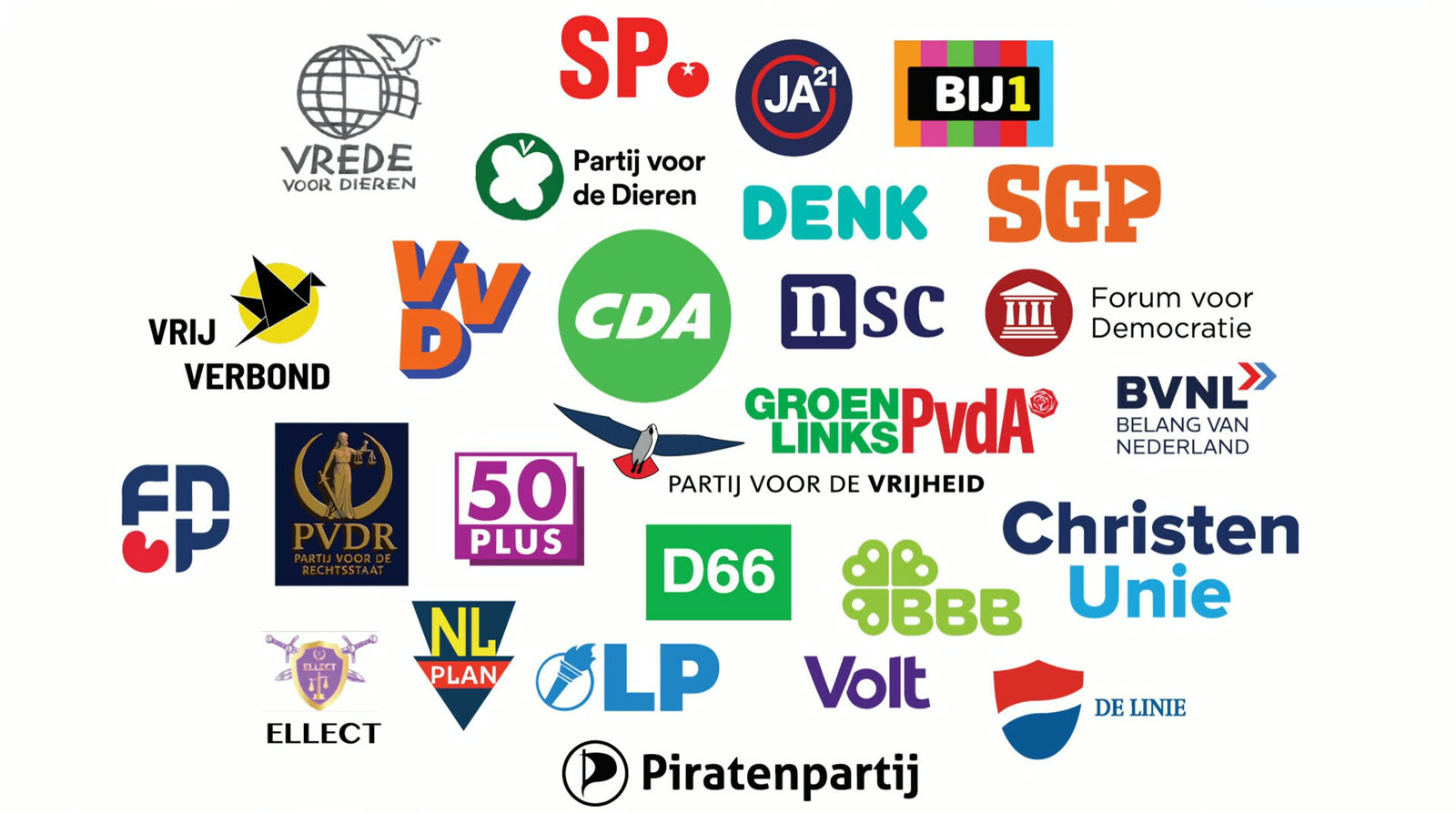
Both of those things allow for an extremely colourful representation and even smaller parties have a shot at getting a seat.
There are different opinions of such a system, but I think it’s absolutely amazing as you have almost direct representation of various voters inside the Parliament, instead of just picking out of a few parties where you don’t like both. In that sense, I never understood how the American system can even be called a democracy where the elections basically come down to two parties. In that sense, I think the Dutch system is way better. But it’s just my personal opinion.
This is how the parliament distribution looks after the election, and it’s kinda beautiful. After the 2025 election, we had 15 parties in the parliament with at least one seat. Since then, a few members split off from PVV and BBB, so now there are 17 groups in the Tweede Kamer.
Seats in the Tweede Kamer after the October 2025 election
150 seats split between 15 parties, roughly where they sit in the chamber. A majority needs 76.
Majority
| Party | 2023 | 2025 | Change |
|---|---|---|---|
| PVV | 37 | 26 | −11 |
| D66 | 9 | 26 | +17 |
| VVD | 24 | 22 | −2 |
| GroenLinks-PvdA | 25 | 20 | −5 |
| CDA | 5 | 18 | +13 |
| JA21 | 1 | 9 | +8 |
| FvD | 3 | 7 | +4 |
| BBB | 7 | 4 | −3 |
| SP | 5 | 3 | −2 |
| PvdD | 3 | 3 | 0 |
| DENK | 3 | 3 | 0 |
| ChristenUnie | 3 | 3 | 0 |
| SGP | 3 | 3 | 0 |
| 50PLUS | 0 | 2 | +2 |
| Volt | 2 | 1 | −1 |
| NSC | 20 | 0 | −20 |
Sources: Kiesraad, 2025 results, Kiesraad, 2023 results, Tweede Kamer seating plan
Here’s the political spectrum of all those parties in the parliament, and as you can see, it has a pretty good representation.
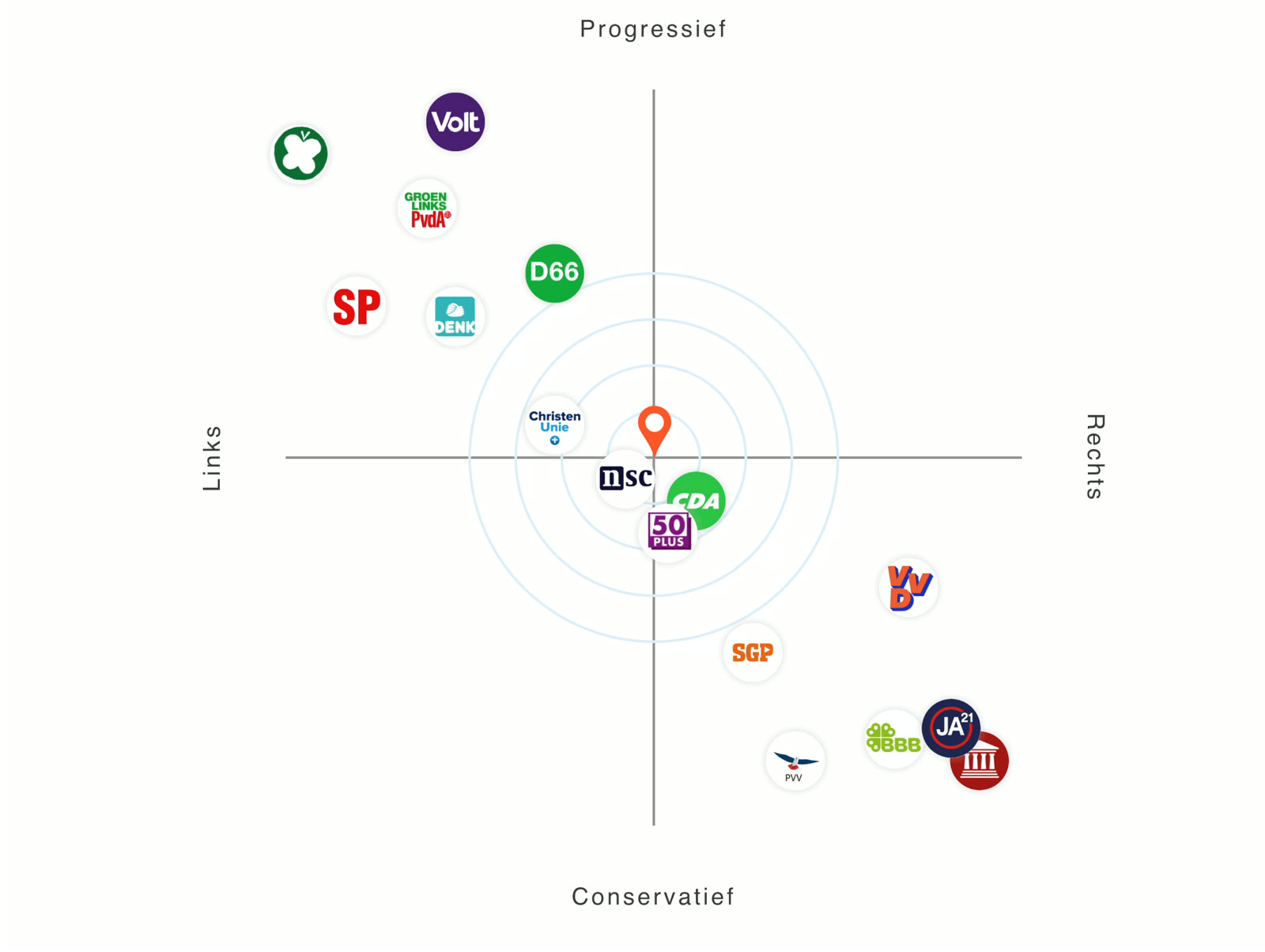
Another unique system that I haven’t seen anywhere else is the voting ballots.
First of all, they are HUGE, absolutely enormous, as they have all the parties’ members on the list. During the election, you actually vote for a person. It technically counts as a vote for a party, but in the distribution of the seats that this party won, it can be filled with candidates that got the most of the votes if they surpass a certain threshold. Otherwise, the seats will be filled in the list order that was published before the election.
I think this also serves as good analytics for parties for the popularity of a certain member.
So after the election results were counted, and all the seats were distributed, we got to the actual government forming.
Forming the government
That’s where we see the small downside of the Dutch political system having such a wide distribution of parties because to form the government, you need a majority, meaning 76 seats. In some countries where just a few parties exist, it might be already settled in the election. In the Netherlands, it’s virtually impossible, and it never happened since the current system was introduced in 1917.
So now parties actually need to talk to each other and form a coalition: multiple parties with a total sum of 76 seats or more.
This is another fun game to play around during the election, and even the biggest broadcaster in the Netherlands, NOS, has a tool that you can use during the election to see what kind of coalitions are possible and see if you like the results.
Build a coalition: it needs 76 of the 150 seats
Tap parties to add them or take them out. It starts with the parties in the government since February 2026: D66, VVD and CDA, a minority coalition.
66
10 short
Source: Kiesraad, 2025 results
Of course, here many things can go wrong, as often right and left don’t want to work together. Some personalities of leaders of the parties can shine through and get a bit more personal than we would like to see in the government.
But overall, I think this system of making actual compromises and settling on the common issues is what I would call an actual democracy. I just wish the personal vendettas were less common here, but when we’re dealing with humans, I think it’s impossible.
Those coalition talks are often led by the party that got the most votes. In 2025, it was the centre-left party D66, with the support of CDA, the Christian democratic centre party. Those talks also can take A LOT of time. In 2021, it took 299 days. Yes, the forming of the government took almost a year after the election. It was a bit of an outlier as it was the longest time in history, but in general, recent elections show that it takes at least 3-4 months as there are many issues to go through and compromise on.
This time, the talks took almost 4 months, so it’s pretty normal.
There are the cases, though rare, where a minority government can be formed. It has downsides as such a government cannot really pass laws alone, so it’ll always need more votes from the rest of the Tweede Kamer for each motion. This is not ideal, but it sometimes happens when a majority coalition cannot be formed. Before this time, the last time it actually happened was back in 2010. And it happened again now, as D66, VVD and CDA formed a minority government with 66 seats.
After all that, the actual forming of the government happens where ministers are appointed, and a majority or minority government starts its actual job. The Prime Minister is very often the leader of the party that got the most votes during the election. But it’s not required. Last time, the leader was so unpopular that they had to bring an independent guy to be appointed as Prime Minister. This time, D66 leader Rob Jetten became the Prime Minister.
Final thoughts
That’s all I wanted to cover today. It’s a very superficial explanation of how the Dutch government works, as there are a lot of nuances that come out of scope of this article, and of course there is a European parliament which plays a huge role in any European country.
I hope it helped you to understand the system a bit better.